We Don’t Need Bigger Homes. We Need Better Ones.
A bigger home is not necessarily a better one. What matters is how intelligently space, light, storage and everyday habits are brought together — and what we choose not to change.
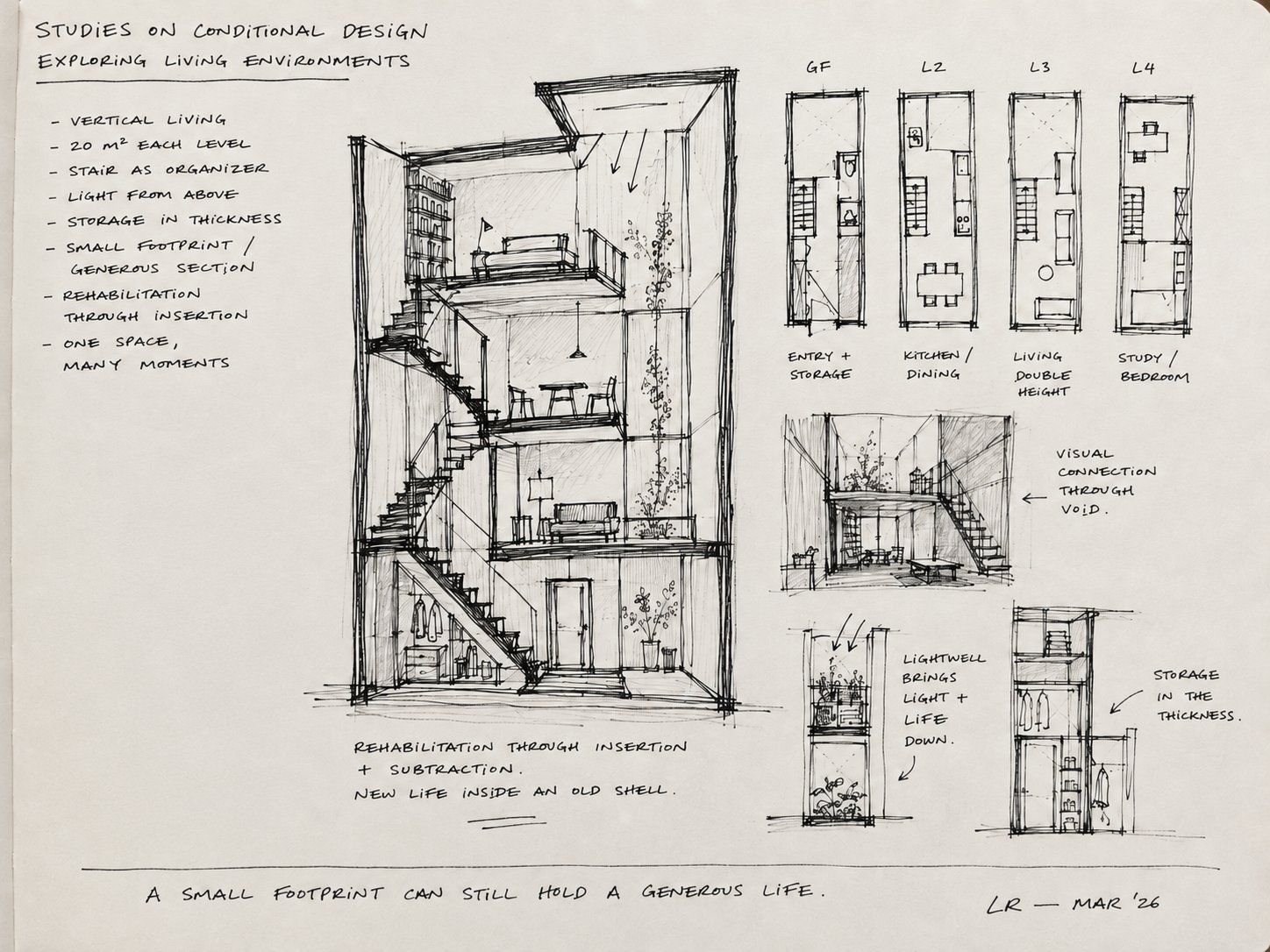
Vertical living study: 20 m² per level, connected through light, void and movement.
For years, one of the easiest ways to describe a desirable home has been through size.
More bedrooms. More square metres. A larger kitchen. Another bathroom. More storage. More space.
But size and quality are not the same thing. A large home can still feel awkward, dark or disconnected. A smaller one can feel generous, calm and remarkably easy to live in.
Japanese architecture offers some of the clearest examples of this. Limited space does not have to mean compromised space. Rational planning, restraint and precision can be beautiful in themselves.
What often makes the difference is not how much space we have, but how intelligently that space works.
Space is not measured only in square metres
We experience a home through movement: the distance between the kitchen and the table, where we leave our keys when we come in, whether two people can move around each other without frustration, where daylight reaches in the afternoon, whether there is somewhere quiet to work, somewhere comfortable to read, somewhere sensible to put the things we use every day.
Very little of that appears on an estate-agent floor plan, and yet it defines much of what makes a home feel good.
A badly organised 120-square-metre apartment can feel more restrictive than a carefully considered 75-square-metre one. The difference is often not size. It is distribution. And distribution is not just a technical exercise; it determines how a home behaves.
Many homes were designed for lives we no longer live
Existing buildings are records of previous ways of living: separate kitchens, formal dining rooms, corridors dividing one function from another, bedrooms designed around different family structures, storage for things we no longer own and no space for things that did not exist when the building was constructed.
This does not mean old homes are obsolete. Quite the opposite. Many have qualities that are increasingly difficult to reproduce: generous proportions, high ceilings, solid materials, craftsmanship, beautiful windows, established neighbourhoods and a sense of permanence.
That is one of the reasons I find existing homes so interesting.
The first question should not be: what can we replace? It should be: what is actually happening here? What still works? What no longer works? What has character? What is simply occupying space because nobody has questioned it for forty years?
A wall may need to move. A kitchen may need to become part of the everyday life of the house rather than a room hidden at the back. A corridor may be doing too much work and contributing too little. A spare bedroom may now need to function as both workspace and guest room.
Sometimes a relatively small intervention changes how an entire home is experienced. I find that far more interesting than change for the sake of change.
Better does not always mean more
Design has a tendency to add: another material, another piece of furniture, another light fitting, another decorative object. Sometimes another “idea”, when the room already has enough.
But some of the most important decisions in a home are acts of removal: removing a partition that interrupts light, furniture that makes a room feel smaller than it is, unnecessary finishes so that original materials can become visible again, visual noise, or decisions that were made separately and replacing them with one coherent idea.
There is a particular generosity in restraint. A room feels larger when circulation is clear. A ceiling feels higher when everything beneath it is calmer. Natural light becomes more noticeable when surfaces and furniture allow it to move.
Often, better design is less about adding value through objects and more about revealing value that was already there.
Storage is architecture too
Storage is a good example. When there is not enough of it, everyday life starts occupying every visible surface.
Shoes gather at the entrance. Coats find the backs of chairs. Kitchen appliances stay permanently on worktops. Suitcases migrate from room to room.
The usual reaction is to buy more storage furniture, which often makes a small home feel even smaller.
Integrated storage works differently. It becomes part of the architecture of the room rather than another object sitting inside it. That may sound like a minor distinction, but it is not. It can completely change how calm, usable and spacious a home feels.
The same is true of lighting, doors, or the relationship between a dining table and the route people take through a room.
None of these are spectacular decisions. But homes are lived through thousands of unspectacular moments. Good design should make those moments easier.
Perhaps we should renovate less, but think more
Renovation is often described through everything that will be replaced: new kitchen, new bathrooms, new flooring, new doors, new finishes.
Even the language pushes us towards substitution. But before asking what should be new, there is another question worth asking:
What is already good?
Perhaps the timber floor can be repaired rather than removed. Perhaps the existing doors need restoring rather than replacing. Perhaps the proportions of a room are already beautiful and the problem is simply how it is furnished. Perhaps the building has a character that the renovation should reveal rather than erase.
There are environmental reasons for thinking this way, of course, but there are architectural ones too. A home becomes more interesting when different moments in its life are allowed to coexist.
I have always found spaces that have been completely stripped of their history slightly unsettling. They can be beautifully finished. Technically immaculate. And still feel anonymous.
Contemporary living does not require architectural amnesia. Sometimes the most contemporary decision is knowing what not to remove.
The best home is specific
Generic ideas about the “perfect home” are rarely very useful because people do not live generically.
Some families need a large shared table more than a formal living room. Someone working from home may value acoustic privacy more than an additional wardrobe. A person who cooks every evening experiences a kitchen differently from someone who rarely does. Someone with hundreds of books needs a different home from someone who collects art. Someone who entertains constantly needs something different from someone who protects home as a place of retreat.
There is no universally correct layout. There is only a layout that responds more or less intelligently to a particular life.
That is why some of the most important work in an interior project happens before anything is drawn. It happens in conversation.
How do you wake up? Where do you eat? Where do you work? What annoys you about the home now? Which room do you avoid? Where does clutter always appear? What do you own that matters to you? What would you hate to lose?
These are ordinary questions. That is precisely why they matter.
Architecture is often discussed through big ideas. Homes are usually improved by understanding small habits.
Homes should be designed for living, not only for looking
We increasingly encounter interiors through photographs, and photographs reward certain things: perfect compositions, empty surfaces, dramatic materials, carefully arranged objects.
I love a beautiful image as much as anyone working in design. But a home cannot remain a photograph.
Someone eventually puts a bag on the table. A child leaves something on the floor. There are cables, laundry, breakfast, visitors, work calls, open windows and half-read books.
Life is visually inconvenient.
Good residential design has to cope with that. More than cope with it, actually. It should become better when life enters it, not worse.
The ambition should not simply be to create a beautiful image. It should be to create a background for everyday life that quietly makes that life easier.
A beautiful home that is irritating to live in is, in the end, not particularly well designed.
So perhaps the question is different
Instead of asking:
How can I get a bigger home?
It may sometimes be more useful to ask:
How can this home become better?
Better connected. Better lit. Better organised. Better adapted. More comfortable. More personal. More capable of changing again in the future.
Because the quality of a home is not ultimately determined by the number at the bottom of the floor plan. It is determined by what those square metres allow us to do, and by how they allow us to live.
That, for me, is the real measure of space.
Founder's Writings · Luis Roy
Thinking about transforming a home?
Explore how we work or tell us about your project.