What Should We Keep?
Good renovation is not about making everything new. It is about understanding what is already there, what deserves to remain, and where change can genuinely improve the way a home is lived.
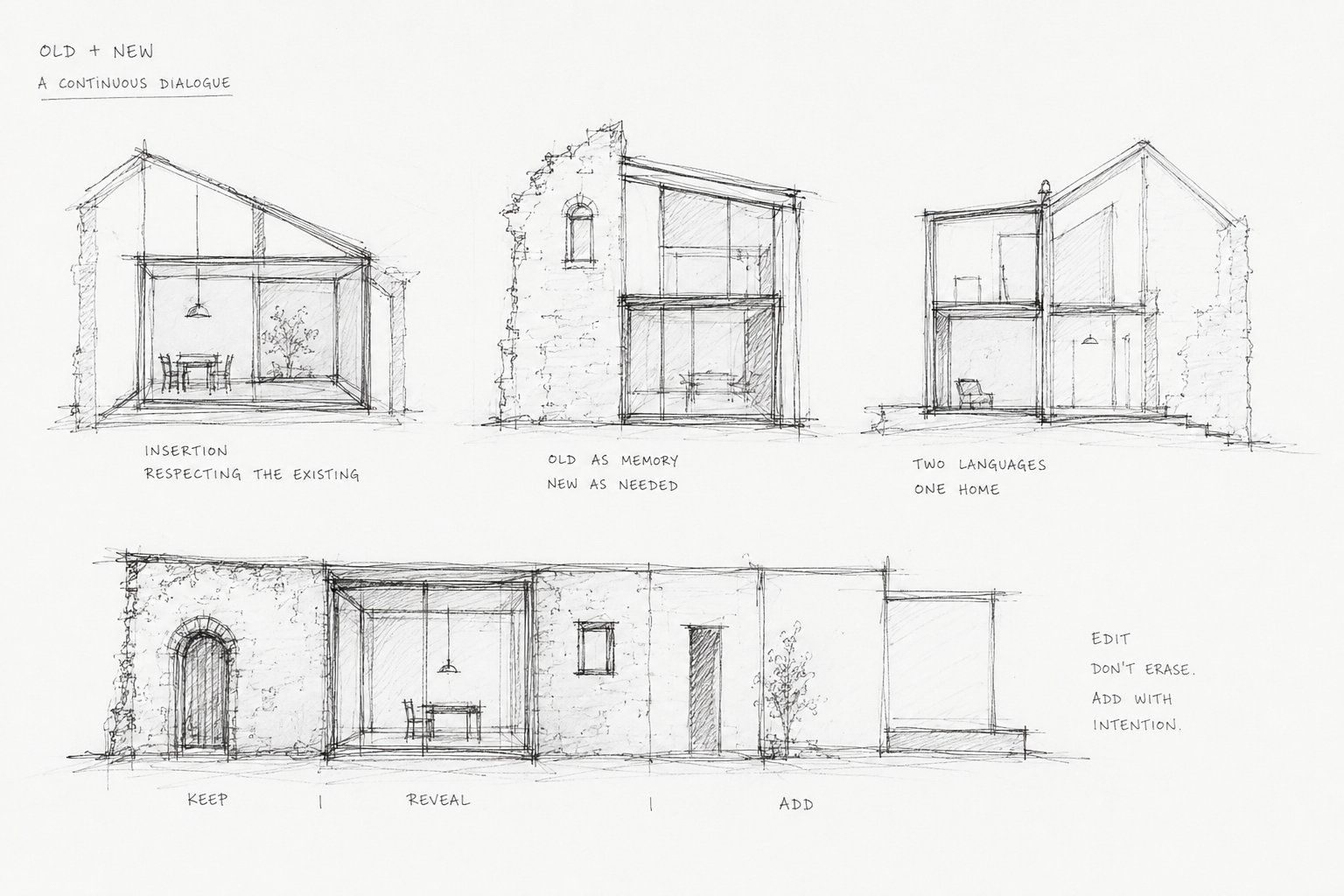
Study on the relationship between old and new: keeping what has character, revealing what matters, and adding only what the next life of the building truly requires.
Renovation as an act of editing
Renovation is often described through what will change. The kitchen will be replaced. The bathroom will be redone. New flooring will be installed. Walls will move. Doors will disappear. New lighting, new joinery, new finishes. Even the language seems to suggest that transformation means replacement. But I increasingly think one of the most important questions in renovation is a much quieter one: what should we keep?
Not because everything old is valuable. It is not. Buildings accumulate compromises, poor alterations, obsolete services, damaged materials and decisions that made sense for another time. But neither is everything new automatically an improvement. Somewhere between preservation and replacement is a more interesting territory: understanding what already has value, removing what obscures it, and adding only what the next chapter of the building actually requires. That, to me, is where renovation becomes architecture.
A building already contains decisions
When we enter an existing home, we are never starting with a blank page. The proportions of the rooms are already there, as are the windows, the direction of the light, the thickness of the walls, the structure, the floors, the doors and the traces of previous occupations. Sometimes several generations of alterations are layered on top of one another. Some of those decisions are excellent, some accidental, and some have simply become inconvenient because the way we live has changed.
The temptation is to judge everything immediately: keep this, demolish that, open this wall, replace this floor. I prefer to spend some time before making those decisions. Where does the light fall in the morning? Why is one room particularly pleasant while another feels uncomfortable even though it is larger? Is the corridor really unnecessary, or does it provide a degree of privacy that would be difficult to recover later? Is an old door inconvenient, or simply badly positioned? Is a damaged timber floor beyond repair, or has nobody seriously considered repairing it?
Buildings often reveal their qualities slowly. The danger of renovating too quickly is that we remove the very things that gave a place its character before we have properly understood them.
Keeping something does not mean freezing it
There is a difference between conservation and nostalgia. I am not interested in treating every old element as sacred simply because it has survived. Homes have to work. A beautiful apartment with an unusable kitchen is still an apartment with an unusable kitchen. A charming corridor that consumes a quarter of the floor area may need to be reconsidered. An original bathroom may have historical character and still be completely inappropriate for contemporary life.
The question is not whether something is old or new. The question is whether it still contributes.
Sometimes the best decision is restoration. Sometimes adaptation. Sometimes removal. And sometimes the most respectful thing we can do to an existing building is introduce something clearly contemporary rather than imitate what was there before. Old and new do not need to pretend to be the same thing. In fact, I often find interiors more interesting when you can read both: an imperfect existing wall beside a precise new piece of joinery; original timber flooring continuing into a newly opened room; an old ceiling retained above a very simple contemporary kitchen; a traditional door repaired while a new opening beside it is deliberately quieter.
The conversation between different periods can be richer than either one on its own.
Renovation is partly subtraction
We tend to imagine design as an additive process. We add furniture, materials, lighting, storage, colour and technology. But renovation is often improved by subtraction.
Remove a false ceiling and perhaps the original height of the room returns. Remove an unnecessary partition and daylight reaches much further into the home. Remove three competing floor finishes and the apartment suddenly begins to feel like one continuous place. Remove furniture that was compensating for poor storage and the proportions of the room become visible again. Remove years of superficial interventions and sometimes the underlying building is considerably better than expected.
This is why I think of renovation as a form of editing. An editor does not improve a text by simply adding more words. The work is deciding what matters, what repeats itself, what distracts, what should disappear and what deserves more emphasis. Interiors can be approached in much the same way.
Character is not something we should have to add later
There is a curious pattern in renovation. A home is stripped completely. Original doors disappear. Floors are removed. Walls are covered. Mouldings vanish. Every surface becomes new. Then, once everything is perfectly clean and neutral, we begin looking for ways to give the space “character”.
We introduce aged timber, textured plaster, vintage furniture, handmade tiles, objects with patina and materials designed to look as though they have already lived another life. There is nothing wrong with any of those things, but occasionally we have destroyed genuine character only to replace it with a manufactured version of the same idea.
Before removing something, it is worth asking whether what we are trying to achieve afterwards is already present. Perhaps not in perfect condition. Perhaps not exactly where we want it. But present nevertheless.
Imperfection can carry value
One of the difficult things about renovation is deciding how perfect the finished result should be. Construction naturally moves towards precision: straight lines, smooth surfaces, consistent finishes. These things matter. But absolute perfection is not always the same thing as quality.
A repaired timber floor may show where a wall once stood. Old brickwork may contain several slightly different tones. A restored door may carry small marks from previous decades. Existing walls are rarely as geometrically perfect as new plasterboard. Sometimes these irregularities should be corrected. Sometimes they are precisely what gives an interior depth.
The skill lies in recognising the difference between something that feels neglected and something that feels lived. There is a point at which repair becomes erasure.
Sustainability begins before specification
We often discuss sustainable interiors through the materials we intend to buy. Which timber? Which insulation? Which paint? Which tile? What is its carbon footprint? Where was it produced? These are necessary questions, but there is another one that should come before all of them:
Do we need to replace this at all?
The lowest-impact floor may be the one already in the building. The most sustainable door may be the one that has been opening and closing for eighty years. The most responsible kitchen intervention may sometimes be replacing fronts, improving storage and changing a worktop rather than sending an entire functioning kitchen to landfill.
This does not mean keeping things at any cost. Existing materials can be damaged, unsafe, inefficient or unsuitable. But reuse should at least be part of the conversation. Sustainability becomes much more tangible when it influences what we decide not to demolish.
Budget can improve a project
Limited budgets are usually described as constraints, and of course they are. But constraints can also force clarity. When it is impossible to replace everything, priorities become much more visible. What actually changes the experience of the home most?
Perhaps it is not new flooring throughout, but opening one carefully chosen wall. Perhaps the existing kitchen cabinets can remain while the relationship between kitchen and dining space changes completely. Perhaps money is better spent restoring windows, improving lighting and building one excellent piece of integrated storage than distributing the same budget across twenty cosmetic changes.
A renovation does not have to change every surface to transform a home. Sometimes one decisive intervention does more than a long list of replacements.
The most valuable thing may be invisible at first
One of the reasons I enjoy working with existing buildings is that their potential is not always immediately obvious. A badly furnished room can disguise beautiful proportions. A dark entrance may be one carefully placed opening away from receiving natural light. A forgotten service area may become an unexpectedly useful workspace. Two rooms that seem unrelated may suddenly make sense once circulation changes.
Good renovation often involves seeing something that is already present but has not yet been allowed to work properly. That requires imagination, but also restraint. The project is not always asking us to invent something. Sometimes it is asking us to notice something.
Homes should be allowed to have a memory
Buildings change because people change. Families grow and shrink. Ways of working evolve. Kitchens become social spaces. Bedrooms become offices. Technology appears. Expectations of comfort move on. A home should be capable of responding to those changes, but I do not think each transformation needs to erase the one before it.
There is something reassuring about an interior that contains evidence of time. Not as decoration. Not as nostalgia. Simply as continuity.
A home can be contemporary without looking as though it was completed yesterday. In fact, perhaps some of the most successful renovations are the ones where it becomes difficult to tell exactly where the existing building ends and the new intervention begins—not because the new work imitates the old, but because both belong naturally to the same place.
So perhaps renovation begins with a different question
Before asking what can we change?, perhaps we should ask what deserves to remain?
What has quality? What has character? What still works? What can be repaired? What can be adapted? What is preventing the home from working better? And only then: what should we add?
Renovation is not the art of making everything new. It is the art of understanding what is already there well enough to know what the next intervention should be.
Sometimes transformation means adding. Sometimes it means removing.
And sometimes the most important design decision is simply knowing what not to touch.
Founder's Writings · Luis Roy
Thinking about transforming a home?
Explore how we work or tell us about your project.